
SEO Strategy Basics: How H1 Tags, Meta Titles, and Meta Descriptions Actually Drive Patient Traffic
Here’s something that drives me crazy. A healthcare practice spends $3,000 a month on SEO, and when I pull up their site, every single page has the same meta title: “Home | [Practice Name].” Their H1 tag says “Welcome…

On This Page
Here’s something that drives me crazy. A healthcare practice spends $3,000 a month on SEO, and when I pull up their site, every single page has the same meta title: “Home | [Practice Name].” Their H1 tag says “Welcome to Our Practice.” Their meta descriptions? Auto-generated gibberish that Google pulled from their footer.
These aren’t minor details. These three elements (your H1 tag, your meta title, and your meta description) are the first things Google reads to understand what your page is about, and the first things patients see before they ever click through to your site. Get them wrong, and it doesn’t matter how good your content is. You’re invisible.
When I was running operations for a multi-location healthcare clinic, I watched our organic traffic jump 34% in 60 days after we did nothing but fix these three elements across our top 20 pages. No new content. No backlinks. Just making sure Google understood what we were offering and patients had a reason to click.
Let me break down exactly what each one does, how to write them, and the mistakes I see on almost every healthcare website I audit.
What H1 Tags, Meta Titles, and Descriptions Actually Do
Before we get into the how, let’s get clear on the what. These three elements serve different purposes, and most practice owners (and honestly, most agencies) confuse them.
Element
Where It Appears
Who It’s For
Character Limit
H1 Tag
Top of your webpage (visible to visitors)
Google’s crawlers + your patients
No hard limit, but 60-70 chars is ideal
Meta Title
Browser tab + Google search results (blue link)
Google’s algorithm + searchers
50-60 characters
Meta Description
Below the blue link in Google results
Searchers deciding whether to click
150-160 characters
Think of it this way: your meta title is the headline on a billboard. Your meta description is the subtext that makes someone pull over. And your H1 tag is the sign on the front door confirming they’re in the right place.
All three need to work together. When they don’t, you confuse Google and patients, and confused people don’t book appointments.
The H1 Tag: Your Page’s Most Important Headline
Your H1 tag is the main heading on the page. Every page should have exactly one H1 tag, and it should clearly communicate what that page is about. Google uses it as a primary signal to understand your content’s topic and relevance to search queries.
Here’s what I typically see on healthcare sites:
- Bad: “Welcome to Our Practice” (tells Google nothing)
- Bad: “Services” (too vague, every competitor has this)
- Good: “Botox and Dermal Fillers in Austin, TX” (specific, keyword-rich, location-targeted)
- Good: “Comprehensive Dermatology Care for Acne, Eczema, and Skin Cancer” (clear scope, relevant keywords)
Your H1 should include your primary keyword for that page and, for service pages, your location. If your website was designed without this in mind, it’s one of the fastest fixes you can make.
H1 Tag Rules for Healthcare Pages
- One H1 per page. Period. Multiple H1s dilute your signal to Google.
- Include your target keyword naturally. Don’t stuff it.
- Make it specific to that page. If you swapped your H1 onto a different page and it still made sense, it’s too generic.
- Add your city or region for local SEO relevance.
- Keep it under 70 characters so it displays cleanly.
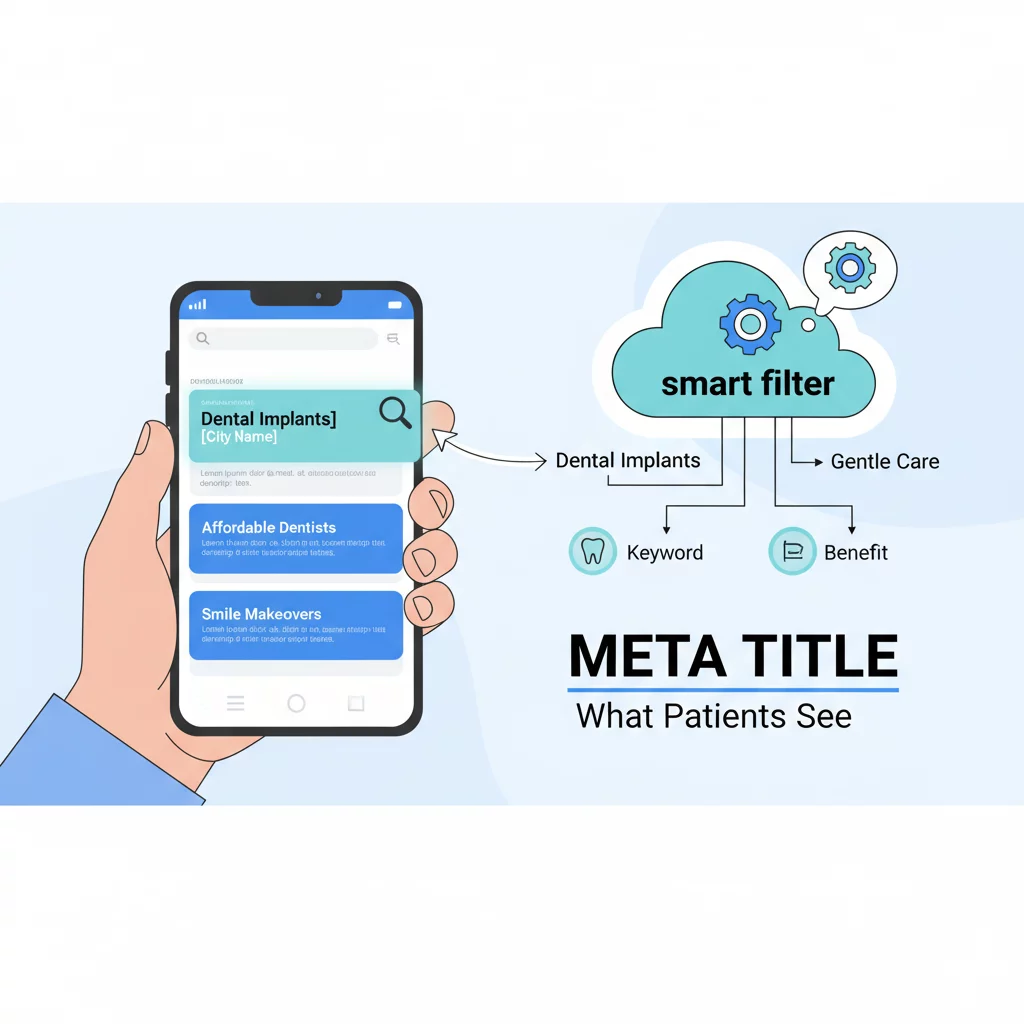
Meta Titles: What Patients See Before They Click
Your meta title (also called a title tag) is arguably the single most important on-page SEO element. It’s the blue clickable link in Google’s search results, and it directly impacts both your rankings and your click-through rate.
I audited a dermatology practice last year that was ranking on page two for “dermatologist near me.” Their meta title was the default WordPress output: “Page 1 | Practice Name.” We rewrote it to “Top-Rated Dermatologist in [City] | Acne, Skin Cancer, Cosmetic Treatments” and they moved to position 6 within three weeks. Same content. Same backlinks. Just a better title tag.
“Your meta title is free ad copy that runs 24/7 on Google. Most healthcare practices treat it as an afterthought, and then wonder why their click-through rate is below 2%.”
How to Write Meta Titles That Rank and Get Clicked
- Lead with the keyword. Google gives more weight to words at the beginning of the title.
- Include your location. “Chiropractor in Denver” beats “Chiropractor” for local search every time.
- Add a value hook. What makes you different? “Same-Day Appointments,” “Board-Certified,” “Accepts Most Insurance.”
- Stay under 60 characters. Google truncates anything longer, which looks sloppy and loses information.
- Make each page unique. Duplicate title tags across pages is one of the most common SEO mistakes, and it’s an easy one to avoid.
If your site is losing visitors before they even land on your pages, your meta titles are likely part of the problem. This ties directly into why healthcare websites lose 97% of their visitors, since the leaks often start in the search results themselves.
Meta Descriptions: Your Free Google Ad Copy
Meta descriptions don’t directly affect rankings. Google has confirmed this. But they massively affect whether someone clicks your result over the next one. And click-through rate does influence rankings over time.
Your meta description is 150-160 characters of persuasion. It needs to do three things:
- Confirm relevance. Echo the search intent so the user knows your page answers their question.
- Differentiate. Why should they click your result instead of the other nine on the page?
- Include a call to action. “Book online,” “See pricing,” “Learn more.” Tell them what to do next.
Here’s a real example from a practice I worked with. Their Botox page had no meta description, so Google auto-generated one from their navigation menu: “Home | About | Services | Contact | Blog.” We replaced it with: “Get natural-looking Botox results from board-certified injectors in [City]. See before/after photos and book your consultation today.” Click-through rate went from 1.8% to 4.6%.
That’s the same ranking position, more than double the clicks. More clicks, more patients, zero additional ad spend. If you’re investing in Google Ads alongside organic, your descriptions should work just as hard as your paid ad copy.
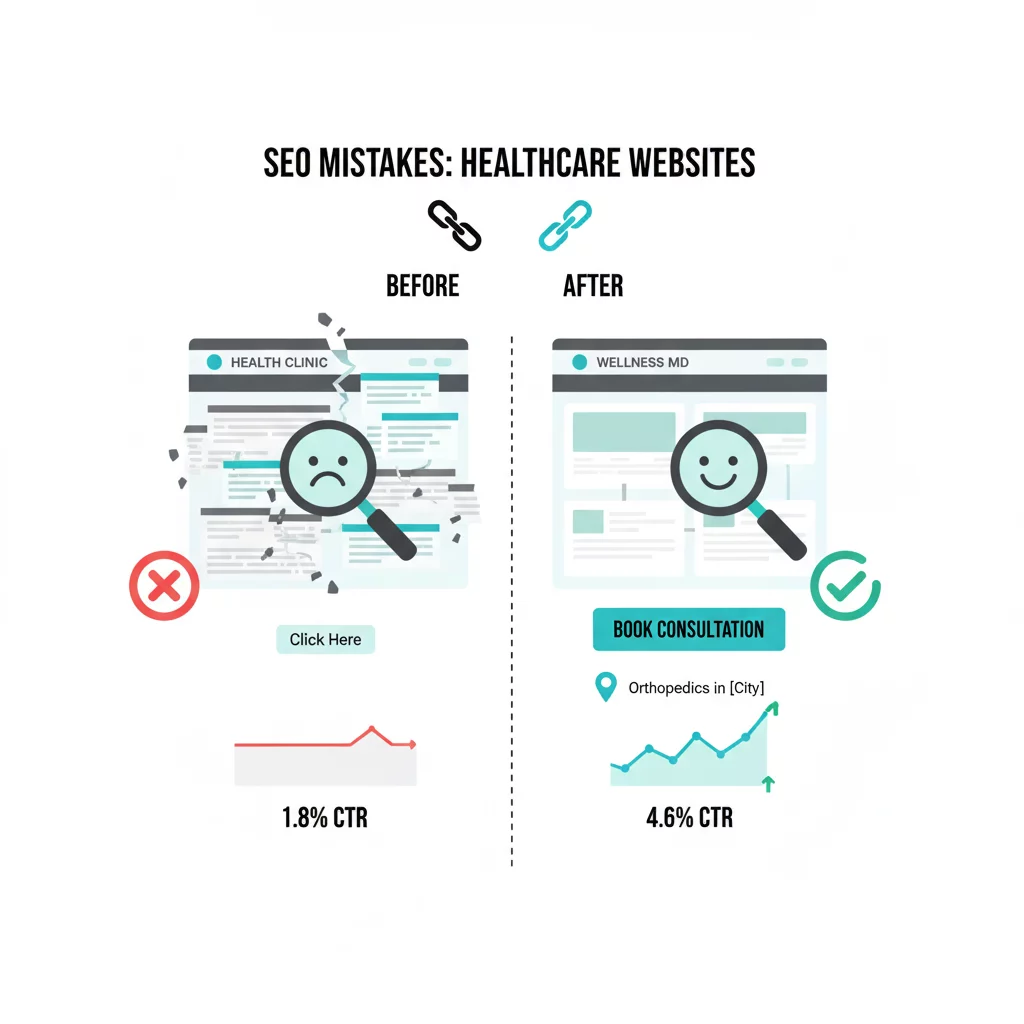
Common SEO Mistakes on Healthcare Websites
After auditing dozens of medical practice websites, I see the same patterns over and over. Here are the ones that cost you the most traffic:
- Duplicate meta titles across pages. Your homepage, services page, and Botox page all say “[Practice Name] | Medical Spa.” Google can’t differentiate them.
- Missing meta descriptions entirely. If you don’t write one, Google pulls random text from your page, usually something useless.
- Multiple H1 tags on one page. Your designer used H1 styling for visual emphasis without understanding the SEO implications.
- Keyword stuffing in titles. “Botox Botox Injections Botox Near Me Botox [City]” doesn’t work. It gets you flagged, not ranked.
- Ignoring your Google Business Profile. Your on-page SEO means nothing if your Google Business Profile is incomplete and sending mixed signals.
The frustrating part? These are all fixable in an afternoon. You don’t need a massive SEO overhaul. You need someone who actually looks at the basics, and most agencies skip right past them to sell you the shiny stuff.
How to Audit Your Own H1, Meta Title, and Meta Description
You can check these yourself right now. Here’s how:
- Check your meta title: Open your site in Chrome and hover over the browser tab. That’s your title tag. Or right-click, “View Page Source,” and search for <title>.
- Check your H1: Right-click your main heading, click “Inspect,” and verify it’s wrapped in an <h1> tag, not an <h2> or a styled <div>.
- Check your meta description: In the page source, search for meta name=”description”. If nothing comes up, you don’t have one.
- Repeat for every key page: Your homepage, each service page, your location pages, and your top blog posts.
If any page is missing these elements, has duplicates, or uses generic text, that’s where you start. These quick wins compound. Practices that achieve the lowest cost per lead almost always have their on-page SEO fundamentals locked down first.
The Bottom Line on SEO Fundamentals
H1 tags, meta titles, and meta descriptions aren’t glamorous. Nobody’s winning marketing awards for a well-written title tag. But these are the foundation everything else sits on: your content marketing, your paid advertising, your local SEO strategy.
Get these right, and every other marketing dollar you spend works harder. Get them wrong, and you’re building on a cracked foundation, pouring budget into a site that Google can’t properly index and patients scroll right past in the search results.
If you’re not sure where your site stands, we’ll tell you. No pitch, no pressure, just a clear-eyed look at what Google sees when it crawls your pages and what patients see before they decide to click.
Ready to see results for your practice?
30-minute strategy call. Direct access to Kevin Dillon, an operator who's scaled healthcare businesses to Inc 5000. No account managers, no pitch deck, just answers.
Book a Free ConsultationMore Tips & Tricks

Healthcare Website Cleanup Case Study: Old-URL Detours Fell From 22 to 4
The audit logged 22 alerts for internal links that routed through old web addresses before reaching live pages. Sixteen days later it logged four. Here is why those detours, zero-inbound pages, and overlapping-copy alerts mattered, and what the audit can actually prove.

Healthcare Marketing Audit: Where Your Budget Goes
Paying for SEO, ads, and three subscriptions nobody remembers? Here is the exact step-by-step process to trace every marketing dollar from your bank account to a booked patient.

7 Conversion Killers on Healthcare Websites
Most medical practices invest in building a website but overlook the details that actually turn visitors into patients. Understanding why healthcare websites lose visitors is the first step toward fixing the problem. At…