
Why Your Marketing Leads Aren’t Converting (It’s Not What You Think)
Your Agency Says You’re Winning. So Why Is Your Schedule Empty? I’ve sat in this meeting before, but from your side of the table. Back when I was running operations for a multi-location healthcare clinic, our marketing…

On This Page
Your Agency Says You’re Winning. So Why Is Your Schedule Empty?
I’ve sat in this meeting before, but from your side of the table.
Back when I was running operations for a multi-location healthcare clinic, our marketing agency would come in quarterly with reports that looked like a highlight reel. Impressions up 20%. Click-through rate beating industry benchmarks. Cost per click trending down. They’d leave, and I’d walk back to the front desk where my staff was fielding the same trickle of appointment requests we always had.
The numbers said we were crushing it. The schedule said otherwise.
I learned something that changed how I think about healthcare marketing entirely: most agencies are measuring the wrong things. And that disconnect between what they report and what you experience isn’t a mystery. It’s a math problem with a solvable answer.
Let me show you where the breakdown happens and what to do about it.
The Metrics That Sound Good But Don’t Pay Your Staff
When you get your monthly marketing report, what do you see? Probably something like this:
Impressions: 50,000. Clicks: 1,200. Click-through rate: 2.4%. Cost per click: $3.50.
These numbers aren’t meaningless. They tell you that your ads are being shown, that people are clicking on them, and roughly what you’re paying for that attention. But here’s what they don’t tell you: whether any of those clicks turned into actual patients sitting in your treatment rooms.
The uncomfortable truth is that many marketing agencies stop their accountability at the click. They’ve delivered traffic to your website. Job done. What happens after that? Not their department.
But it is your department. It’s the only department that matters when you’re trying to make payroll and grow your practice.
I’ve audited dozens of healthcare marketing accounts at this point, and the pattern is consistent. Practices are paying for clicks that never had a chance of becoming patients. The ad copy attracted the wrong people. The landing page confused or lost them. The form asked for too much too soon. The follow-up took too long or never happened.
Each of these breakdowns is fixable. But you can’t fix what you’re not measuring.
Where the Real Breakdown Happens: Ad Copy and Landing Pages
Let’s trace the patient journey from ad to appointment and look at where things typically fall apart.
The Ad Copy Problem
Your Google Ad is a filter. It should attract the right people and repel the wrong ones. Most healthcare ads fail at this because they’re written to maximize clicks rather than qualified clicks.
I see this constantly: ad copy that’s so generic it could apply to any practice in any specialty. “Quality Care You Deserve.” “Compassionate Treatment.” “Accepting New Patients.” These phrases get clicks because they’re inoffensive and vague. But vague ads attract vague interest.
Compare that to ad copy that does the filtering work upfront: “Chronic Back Pain? Non-Surgical Spinal Decompression in [City]. Most Insurance Accepted.” This ad will get fewer clicks. That’s the point. The clicks it does get are from people who actually have the problem you solve, in your area, wondering about their insurance.
Your click-through rate might drop. Your cost per click might rise slightly. But your cost per qualified lead? That’s going to improve dramatically.
If you’re running ads yourself or reviewing what an agency has set up for you, look at your ad copy through this lens. Ask yourself: would someone who isn’t actually a good fit for my practice still click this? If the answer is yes, your ads are too broad.
The Landing Page Problem
Let’s say your ad copy is solid and you’re attracting the right people. They click. Now what?
If they land on your homepage, you’ve already lost a significant percentage of them. Your homepage is designed to serve everyone: existing patients, job seekers, referral partners, curious browsers. A person with a specific problem who clicked a specific ad needs a specific answer.
This is where dedicated landing pages make a significant difference. A good landing page does exactly three things:
First, it confirms the visitor is in the right place. The headline should mirror the promise or problem from the ad. If your ad mentions chronic back pain, your landing page headline should mention chronic back pain. This sounds obvious, but I audit pages weekly where the ad talks about one thing and the page talks about something else entirely.
Second, it builds enough trust to take the next step. This doesn’t mean cramming your page with every credential and testimonial you have. It means answering the specific objections someone has at this moment. For healthcare, those are usually: Is this practice legitimate? Do they treat my specific issue? Will this cost me a fortune? How quickly can I be seen?
Third, it makes the next step effortless. Your form should ask for the minimum information needed to have a conversation. Name, phone, and a brief description of their concern. That’s it. Every additional field reduces conversions. I’ve seen practices asking for insurance information, date of birth, and full medical history before someone can even request a call. Your front desk can gather that information once someone’s actually engaged.
Now, I’ll be honest: not every practice wants to invest in custom landing pages, and that’s a legitimate budget decision. But if you’re sending paid traffic to your homepage, you should know what that’s costing you. Industry data suggests dedicated landing pages convert ~2x better than generic pages. Run the math on your own ad spend and you’ll see whether that investment makes sense for you.
The Metrics That Sound Good But Don’t Pay Your Staff
When you get your monthly marketing report, what do you see? Probably something like this:
Impressions: 50,000. Clicks: 1,200. Click-through rate: 2.4%. Cost per click: $3.50.
These numbers aren’t meaningless. They tell you that your ads are being shown, that people are clicking on them, and roughly what you’re paying for that attention. But here’s what they don’t tell you: whether any of those clicks turned into actual patients sitting in your treatment rooms.
The uncomfortable truth is that many marketing agencies stop their accountability at the click. They’ve delivered traffic to your website. Job done. What happens after that? Not their department.
But it is your department. It’s the only department that matters when you’re trying to make payroll and grow your practice.
I’ve audited dozens of healthcare marketing accounts at this point, and the pattern is consistent. Practices are paying for clicks that never had a chance of becoming patients. The ad copy attracted the wrong people. The landing page confused or lost them. The form asked for too much too soon. The follow-up took too long or never happened.
Each of these breakdowns is fixable. But you can’t fix what you’re not measuring.
The Metrics That Actually Predict Practice Growth
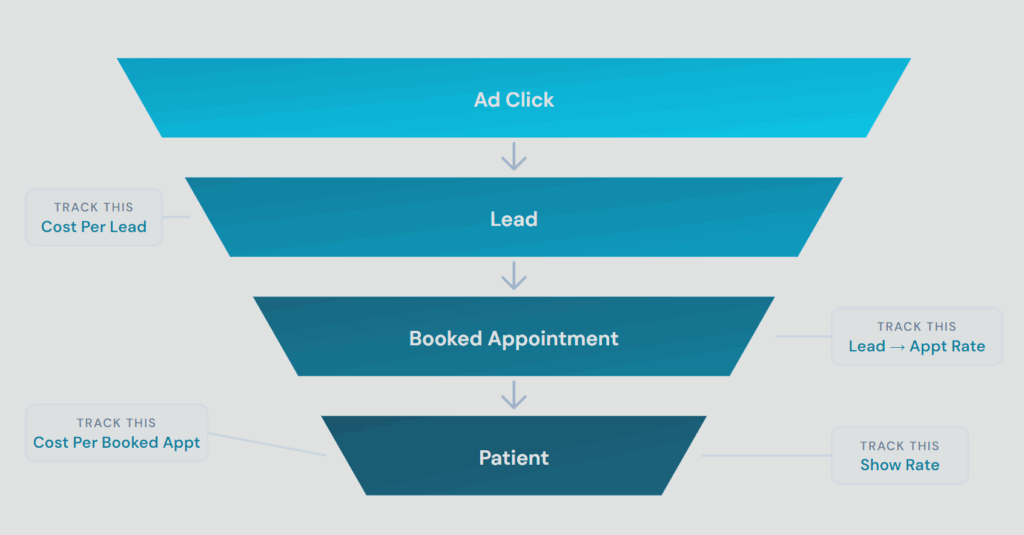
So if clicks and impressions aren’t the answer, what should you be tracking?
Cost per lead. Not cost per click. Cost per lead. A lead is someone who raises their hand and says they want to talk to you. That’s a form submission, a phone call, or a chat request. This number tells you what you’re actually paying to start a conversation with a potential patient.
Lead to appointment rate. Of the leads that come in, what percentage actually book? If this number is below 50%, you have either a lead quality problem or a follow-up problem. Probably both.
Cost per booked appointment. This is the number that matters most. If you’re paying $50 per lead and converting 50% of leads to appointments, your cost per booked appointment is $100. Now you can compare that to your average patient value and know whether your marketing is actually working.
Show rate. What percentage of booked appointments actually walk through your door? No-shows are a leak in your bucket that most marketing reports ignore entirely.
Here’s the catch: getting these numbers requires some setup. You need call tracking so you can attribute phone leads to specific campaigns. You need form tracking connected to your ad platforms. And ideally, you need a way to close the loop between marketing leads and actual booked appointments, whether that’s a CRM, a simple spreadsheet your front desk maintains, or integration with your practice management software.
Some practices set this up themselves. Some work with agencies who build it into their service. Some decide the partial picture is good enough for now. There’s no wrong answer, but you should know what visibility you’re giving up if you’re not tracking these numbers. You’re essentially flying blind on whether your marketing dollars are actually producing patients.
The Question to Ask Your Agency (or Yourself)
Whether you’re working with an agency, a freelancer, or managing marketing yourself, here’s the question that cuts through the noise:
“For every dollar I spend, how many booked appointments does that produce? And what’s the plan to improve that number?”
If your agency can’t answer that question, or if they redirect to click metrics and impression counts, you have a misalignment problem. They’re optimizing for their scorecard, not yours.
This isn’t necessarily malicious. Many agencies genuinely believe that their job ends at driving traffic. That’s the model most of them were built on. But healthcare marketing isn’t e-commerce. You’re not selling a product someone can buy with one click. You’re starting a relationship that requires trust, conversation, and follow-through.
If you’re managing this yourself, the question still applies. It’s easy to get caught up in the metrics that ad platforms put front and center. They want you to see clicks and impressions because those numbers go up and to the right even when business results don’t.
Making This Work for Your Practice
If you’ve recognized your situation in any of this, here’s where I’d start:
Get honest about your current visibility. Can you actually trace a lead from the ad that generated it all the way to whether they showed up for an appointment? If not, that’s the first gap to address. This might mean setting up call tracking, connecting your forms to your ad platforms, or just creating a simple spreadsheet where your front desk logs where each lead came from and what happened to them.
Audit your current ad copy. Are your ads filtering for qualified prospects, or just maximizing clicks? Read your ads from the perspective of someone with the exact problem you want to solve. Would they know this ad is for them? Would someone who isn’t a good fit still click?
Evaluate your landing page situation. Where does your ad traffic actually go? If it’s your homepage, you’re leaving conversions on the table. Whether building a dedicated landing page is worth it depends on your ad spend and your cost per lead. At a certain volume, even a modest improvement in conversion rate pays for itself quickly.
Examine your follow-up process. How quickly do leads get a response? Who’s calling them, and what are they saying? This is often the most overlooked piece of the puzzle, and it’s completely in your control regardless of what marketing setup you’re running.
The practices I’ve seen get the best results aren’t necessarily the ones with the biggest budgets. They’re the ones who understand that marketing isn’t about generating activity. It’s about generating patients. And they’ve built the visibility to know whether that’s actually happening.
Whether you’re running this yourself, working with another agency, or just trying to figure out if your current setup is doing its job, I’m always happy to talk through what you’re seeing. Sometimes a fresh perspective on the numbers you already have reveals exactly where things are breaking down.
Reach out anytime for a conversation.
Ready to see results for your practice?
30-minute strategy call. Direct access to Kevin Dillon, an operator who's scaled healthcare businesses to Inc 5000. No account managers, no pitch deck, just answers.
Book a Free ConsultationMore Tips & Tricks

Healthcare Website Cleanup Case Study: Old-URL Detours Fell From 22 to 4
The audit logged 22 alerts for internal links that routed through old web addresses before reaching live pages. Sixteen days later it logged four. Here is why those detours, zero-inbound pages, and overlapping-copy alerts mattered, and what the audit can actually prove.

Healthcare Marketing Audit: Where Your Budget Goes
Paying for SEO, ads, and three subscriptions nobody remembers? Here is the exact step-by-step process to trace every marketing dollar from your bank account to a booked patient.

7 Conversion Killers on Healthcare Websites
Most medical practices invest in building a website but overlook the details that actually turn visitors into patients. Understanding why healthcare websites lose visitors is the first step toward fixing the problem. At…