
Why Your Half-Finished Google Business Profile Is Costing You Patients
You finally claimed your Google Business Profile. Maybe you uploaded a logo, added your phone number, your website , and called it done. That was two years ago. Here’s the problem: Google treats incomplete profiles the…

On This Page
You finally claimed your Google Business Profile. Maybe you uploaded a logo, added your phone number, your website, and called it done. That was two years ago.
Here’s the problem: Google treats incomplete profiles the way patients treat waiting rooms with outdated magazines. They notice. And they make judgments.
When someone searches “primary care doctor near me” or “dermatologist in [your city],” Google decides which three practices appear in that coveted map pack at the top of results. Your profile completeness is one of the biggest factors in that decision. And if you picked “Medical Clinic” as your only category because it was the first option you saw, you’re likely invisible for dozens of searches your ideal patients are running every single day.
This guide breaks down exactly how to optimize the three most overlooked sections of your Google Business Profile: primary categories, secondary categories, and your business description.
The Map Pack Is Where Patients Make Decisions
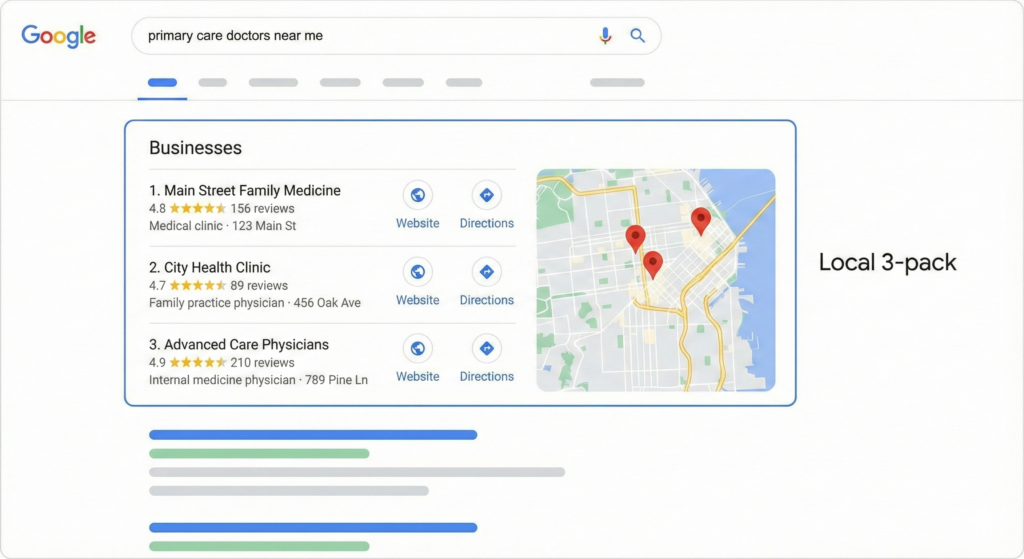
Before we dig into the how, let’s talk about why this matters so much for medical practices specifically.
When patients search for healthcare services, they’re usually ready to act. They’re not browsing. They have a symptom, a referral, or a deadline for that annual physical they’ve been putting off. The map pack, those three business listings that appear with the map at the top of local search results, captures the majority of clicks for local intent searches.
Studies consistently show that businesses appearing in the map pack receive significantly more engagement than those buried in standard organic results below. For medical practices, this translates directly to phone calls, direction requests, and appointment bookings.
Google determines map pack rankings based on three primary factors: relevance, distance, and prominence. Your profile completeness directly impacts relevance and prominence. Distance is the only factor you can’t control, unless you’re planning to relocate your practice based on search patterns.
The practices that show up consistently aren’t necessarily the best in town. They’re the ones that told Google exactly what they do, who they serve, and why they matter.
Primary Category: The Single Most Important Field You’ll Fill Out
Your primary category is the foundation of your local search visibility. It tells Google, in their own language, what your business fundamentally is. This field carries more weight than any other element in your profile.
Here’s where most practices go wrong: they choose something broad like “Doctor” or “Medical Center” because it feels safe and accurate. It is accurate. It’s also what thousands of other practices chose, which means you’re competing in an overcrowded pool while missing searches for your actual specialty.
Google offers remarkably specific healthcare categories. “Pediatrician” and “Pediatric Clinic” are different categories with different search implications. “Orthopedic Surgeon” is separate from “Orthopedic Clinic.” “Medical Spa” is distinct from “Dermatologist.”
To find the right primary category, think about how your ideal patient searches for you. Not how you describe yourself at a networking event. How someone types into Google at 10pm when they realize they need to find a provider.
If you’re an orthopedic practice that primarily sees sports injuries, “Sports Medicine Clinic” might outperform “Orthopedic Clinic” for your target patient base. If you’re a family practice that emphasizes preventive care, “Family Practice Physician” signals something different than “Medical Clinic.”
Check what categories your top-ranking local competitors use. Search your primary service plus your city, look at who’s in the map pack, and click through to their profiles. Google shows their categories. This isn’t about copying. It’s about understanding what Google associates with high-performing profiles in your specialty.
Secondary Categories: Capturing Every Relevant Search
Your primary category handles your core identity. Secondary categories expand your visibility to related searches without diluting your main focus.
Google allows you to add up to nine secondary categories. Most practices add one or two, if any. This is a missed opportunity.
Think through every service line your practice offers. A dermatology practice might legitimately claim: Dermatologist (primary), Skin Care Clinic, Acne Treatment Service, Cosmetic Dermatologist, Laser Hair Removal Service, and Mole Removal Service. Each of these categories corresponds to actual searches patients run.
The key is relevance. Only add categories for services you actually provide at that location. Google’s guidelines are clear that categories should reflect what you are, not what you sell or what happens at your location incidentally. A medical practice with a small retail section for skincare products shouldn’t add “Cosmetic Products Supplier” as a category.
Here’s a practical approach: list every service your practice offers. Then search Google’s category database (you can see available options when editing your profile) for matching or closely related categories. You’ll often find category options you didn’t know existed.
One note of caution: don’t add categories hoping to rank for services you barely offer. If you do Botox injections twice a month as an afterthought, claiming “Injectable Fillers Service” will likely hurt more than help. Patients who find you through that category and discover it’s not your focus will leave reviews reflecting that disconnect.
Your Business Description: 750 Characters to Differentiate
The business description field gives you 750 characters to tell potential patients who you are and what makes your practice worth choosing. Most practices waste this space with generic language that could describe any medical office in the country.
Your description won’t directly impact rankings the way categories do. Google has stated this clearly. But it absolutely impacts whether someone who sees your profile decides to click, call, or keep scrolling.
Write your description for patients, not algorithms. This is your chance to communicate personality, specialization, and value in a way that categories can’t capture.
Start with what you do and who you serve. Be specific. “Family medicine practice serving patients of all ages” tells me nothing. “Family medicine practice specializing in preventive care and chronic disease management for busy professionals and their families” gives me something to connect with.
Include your key services and any notable specializations. If you’re one of three practices in your area offering a specific treatment or technology, mention it. If your providers have relevant subspecialty training, that belongs here.
Address what patients care about. Extended hours, same-day appointments, multilingual staff, specific insurance acceptance. These practical details differentiate you from profiles that read like medical school brochures.
Avoid keyword stuffing. Yes, you want to include terms patients search for. But “best dermatologist skin doctor acne treatment rosacea specialist” reads like spam and turns patients off. Write naturally, with your ideal patient in mind.
End with a soft call to action. “Call today to schedule your consultation” or “New patients welcome” signals that you want their business.
The Compound Effect of a Complete Profile
Each optimization we’ve covered works independently. Together, they create compound returns.
A complete, well-optimized profile signals to Google that you’re a legitimate, active business worth recommending. It captures searches across your full range of services. It gives patients the information they need to choose you over competitors.
Practices that invest thirty minutes in getting these elements right often see measurable improvements in profile views, direction requests, and calls within weeks. Those that revisit and refine their profiles quarterly, adding new services as categories, updating descriptions to reflect current offerings, tend to maintain and improve their map pack positioning over time.
This isn’t about gaming an algorithm. It’s about clearly communicating what your practice does so that Google can connect you with patients actively searching for exactly that.
Make Your Profile Work as Hard as Your Front Desk
Your Google Business Profile is often the first interaction potential patients have with your practice. An incomplete profile sends the same message as a cluttered waiting room or a phone that rings six times before anyone answers. It suggests you’re not paying attention to the details.
The good news is that optimization isn’t complicated. It requires thirty minutes of focused attention and a willingness to think like your patients think when they’re searching.
If you’ve read this far and realized your profile needs work, start with your primary category. It’s the single highest-impact change you can make. Then build from there.
And if you’re looking at your local search presence and realizing you need a more comprehensive strategy, that’s exactly the kind of challenge we help practices solve. Reach out for a conversation about where you stand and what’s possible.
Ready to see results for your practice?
30-minute strategy call. Direct access to Kevin Dillon, an operator who's scaled healthcare businesses to Inc 5000. No account managers, no pitch deck, just answers.
Book a Free ConsultationMore Tips & Tricks

Healthcare Website Cleanup Case Study: Old-URL Detours Fell From 22 to 4
The audit logged 22 alerts for internal links that routed through old web addresses before reaching live pages. Sixteen days later it logged four. Here is why those detours, zero-inbound pages, and overlapping-copy alerts mattered, and what the audit can actually prove.

Healthcare Marketing Audit: Where Your Budget Goes
Paying for SEO, ads, and three subscriptions nobody remembers? Here is the exact step-by-step process to trace every marketing dollar from your bank account to a booked patient.

7 Conversion Killers on Healthcare Websites
Most medical practices invest in building a website but overlook the details that actually turn visitors into patients. Understanding why healthcare websites lose visitors is the first step toward fixing the problem. At…