
Why Your Best Marketing Asset Is Already Walking Around Your Clinic
A potential patient lands on your website. They’re dealing with chronic back pain that’s been getting worse for months. They’ve tried stretching, ice packs, maybe even a few YouTube exercises. Nothing’s working, and now…
On This Page
A potential patient lands on your website. They’re dealing with chronic back pain that’s been getting worse for months. They’ve tried stretching, ice packs, maybe even a few YouTube exercises. Nothing’s working, and now they’re finally ready to see someone about it.
They find your services page. The information looks solid. But before they pick up the phone, they want to answer one question: Can I trust this person with my body?
A wall of text won’t answer that. A stock photo of a smiling doctor definitely won’t. But a 45-second video of your provider explaining how they approach back pain? That changes everything.
Short, authentic videos shot right in your clinic are one of the most underutilized tools in healthcare marketing. They cost almost nothing to produce, they dramatically increase engagement on your website and ads, and they do something no amount of written content can accomplish: they let patients meet your providers before they ever walk through the door.
Here’s how to use them effectively.
I break down this strategy in a recent video. If you prefer watching to reading
The Trust Gap Between Your Website and Your Waiting Room

Healthcare is different from most service businesses. When someone hires a plumber or a financial advisor, there’s a transaction happening. When someone chooses a medical provider, they’re placing their physical wellbeing in another person’s hands.
That’s a significant leap of faith, especially for new patients who found you through a Google search.
Your website’s job is to bridge that trust gap. Most practice websites try to do this with credentials, testimonials, and professional headshots. Those elements matter. But they’re static. They don’t convey personality, communication style, or bedside manner.
Video does.
Research consistently shows that people form impressions within seconds of seeing someone’s face and hearing their voice. A provider intro video gives potential patients those seconds before they commit to an appointment. They get to see how your doctor explains things, whether they seem rushed or patient, and whether their energy feels like someone they’d be comfortable with.
This isn’t about production quality. It’s about human connection.
What Actually Works: Provider Intro Videos That Convert
The most effective provider videos share a few common traits. They’re short, typically under 90 seconds. They’re shot in the actual clinic environment. And they focus on how the provider helps patients rather than listing credentials.
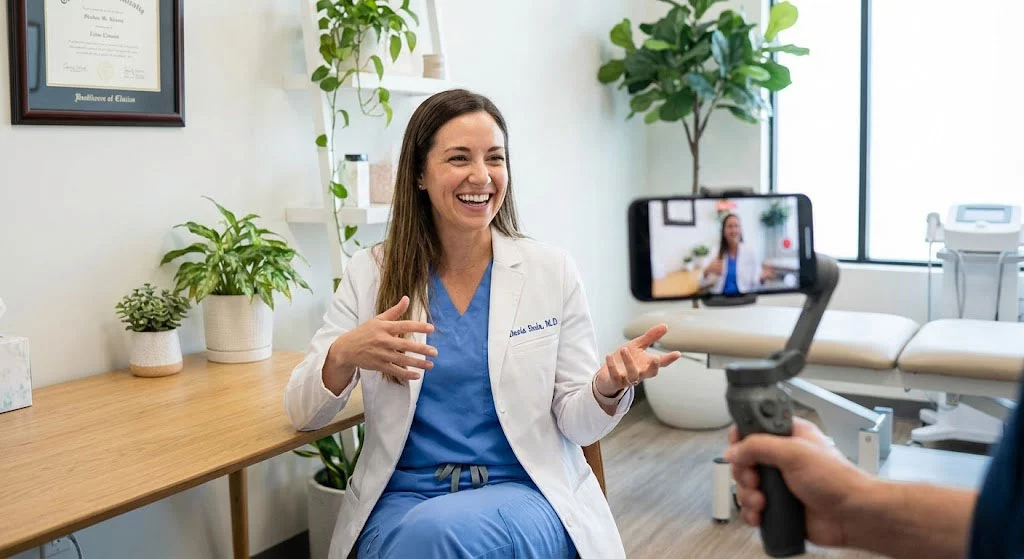
I recently worked with Limitless Spine & Joint Care on exactly this kind of content. We shot several short videos featuring their providers, including one specifically addressing sciatica. The video shows a simple at-home treatment patients can try, then explains how the practice approaches sciatica when home remedies aren’t enough.
That video now lives on their sciatica services page. When someone searches for sciatica treatment and lands on that page, they don’t just read about the condition. They see a real provider from the practice demonstrating that they understand the problem and have a clear approach to solving it.
The video accomplishes multiple goals at once. It builds trust with the viewer. It increases time on page, which signals to Google that the content is valuable. And it gives patients a reason to choose this specific practice over the other options in their search results.
Beyond the Homepage: Strategic Video Placement
Most practices that use video at all put a single intro video on their homepage and call it done. That’s a start, but it barely scratches the surface of what’s possible.
Think about where your potential patients are making decisions. They’re on your services pages, reading about specific conditions. They’re on your provider bio pages, trying to decide which doctor to request. They’re seeing your ads on Google and social media, scrolling past dozens of other options.
Each of those touchpoints is an opportunity for video.
Condition-specific videos work particularly well on services pages. A 60-second video addressing knee pain builds more trust than a 1,000-word article about knee pain. The written content still matters for SEO, but the video is what converts browsers into callers.
Provider bio pages should absolutely include video intros. A written bio tells patients where your doctor went to school. A video tells them whether that doctor seems like someone they’d want to spend time with.
For advertising, short videos create engagement that static images simply can’t match. I’ve used clinic-shot videos in Performance Max campaigns specifically to build engagement metrics. When someone watches even 15-20 seconds of your video ad, that interaction signals interest to the algorithm and improves your campaign’s overall performance.
Production Doesn’t Need to Be Complicated

Here’s where most practices get stuck. They assume video requires professional crews, expensive equipment, and hours of their providers’ time. So they never get started.
The truth is much simpler. A modern smartphone shoots video quality that would have required $10,000 in equipment a decade ago. Natural lighting from a window often looks better than professional lighting setups. And a 45-second video can be filmed in a single take.
The key is having a clear plan before you hit record.
Start by identifying your highest-value pages. Which services drive the most revenue? Which conditions do patients most commonly search for? Those pages should get videos first.
Script a loose outline, not a word-for-word script. You want your providers to sound like themselves, not like they’re reading a teleprompter. Give them three or four talking points and let them speak naturally.
Keep videos focused on one topic each. A provider intro video should introduce the provider. A sciatica video should address sciatica. Trying to cover everything in one video results in content that’s too long and too unfocused to be effective.
Film in the actual clinic. The waiting room, an exam room, wherever looks clean and professional. This authenticity matters more than a fancy backdrop. Patients want to see where they’ll actually be receiving care.
Using Video to Strengthen Your Ad Campaigns
Paid advertising for medical practices is increasingly competitive. Cost-per-click has risen significantly across healthcare keywords over the past few years, and standing out in a crowded market requires more than just a higher bid.
Video gives you an edge.
On platforms like Google’s Performance Max and Meta Ads, video content typically generates higher engagement rates than static images. That engagement feeds back into the algorithm, improving your ad performance and often lowering your cost per acquisition.
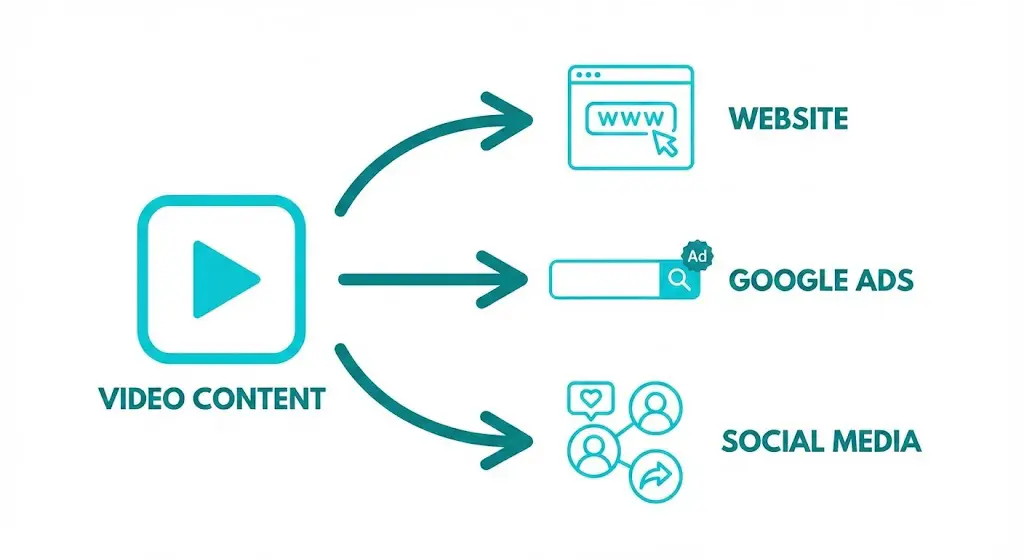
But there’s a secondary benefit that’s easy to overlook. When you use the same videos in your ads that appear on your website, you’re creating consistency throughout the patient journey. Someone who saw your provider in a YouTube ad recognizes them when they land on your services page. That recognition accelerates trust.
The sciatica video I mentioned earlier serves double duty. It lives on the website’s services page where it builds trust and engagement time for SEO purposes. But it also runs in ad campaigns, generating impressions and clicks while establishing brand recognition before the patient ever visits the site.
This kind of content efficiency matters for practices that don’t have unlimited marketing budgets. You’re not creating separate assets for separate channels. You’re creating once and deploying strategically everywhere.
Making Video Part of Your Ongoing Strategy
The practices that see the best results from video don’t treat it as a one-time project. They build video into their regular marketing rhythm.
A new provider joins the practice? Shoot an intro video during their first week. Launching a new service? Create a short explainer before the service page goes live. Getting the same question from patients over and over? That’s a video topic.
Over time, you build a library of content that serves multiple purposes. Your website becomes more engaging. Your ads perform better. Your providers become recognized faces in the community. And patients arrive for their first appointment already feeling like they know who they’re about to meet.
That feeling is worth more than almost any other marketing outcome you can measure.
Start Simple, Start Now
If you’ve been putting off video because it feels complicated or expensive or time-consuming, I’d encourage you to reconsider. The gap between practices that use video effectively and practices that don’t is widening. And the longer you wait, the more your competitors have the opportunity to build that trust with your potential patients first.
You don’t need a production budget. You need a smartphone, a quiet room with decent lighting, and a provider who’s willing to spend five minutes talking about what they do.
That’s it. That’s the whole barrier to entry.
If you’re not sure where to start or want to think through a video strategy that makes sense for your specific practice, feel free to reach out. This is something we help practices implement regularly, and I’m always happy to talk through what might work for your situation.
Ready to see results for your practice?
30-minute strategy call. Direct access to Kevin Dillon, an operator who's scaled healthcare businesses to Inc 5000. No account managers, no pitch deck, just answers.
Book a Free ConsultationMore Tips & Tricks

Healthcare SEO: Service Pages or Condition Pages?
Should a healthcare practice build a service page or a condition page? Use a patient-first framework to choose, link, and measure the pages that matter.

Telehealth Website Design: Put the Provider Before the Office
For a telehealth-only practice, the provider is the experience. Learn how to design for trust and earn organic search visibility without a physical office.

CRO Optimization: Why Healthcare Websites Lose 97% of Visitors
Here’s a number that should bother you: the average healthcare website converts between 2-3% of visitors into leads or booked appointments. For every 100 people who find your practice online, 97 leave without taking…